



5 Signs of a Bent Rim (And How to Tell Before It Fails)

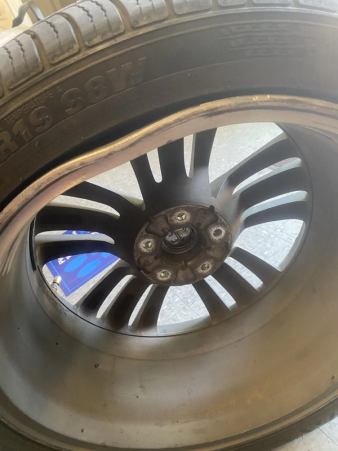
Most drivers don't think about their wheel rims until they slam into a Southern California pothole or scrape a curb while parallel parking. But your rims are structural components, not just cosmetic ones. A bent rim does more than ruin your car's look — it stresses your tires, suspension, and steering, and the damage compounds the longer you drive on it.
Because your tire absorbs part of every impact, a bent rim isn't always visible to the naked eye. Here are the five warning signs to watch for, the real risks of ignoring them, and how professional wheel straightening can save you the cost of a brand-new wheel.
What Causes a Bent Rim?
Tires are flexible rubber; wheels are rigid aluminum alloy or steel. Hit an obstacle with enough force and the tire bottoms out, letting the impact transfer directly into the metal. The usual culprits:
- Potholes. Striking a deep pothole at speed compresses the tire completely and slams the rim edge into hard pavement.
- Curbs. Clipping or scraping a concrete curb while turning or parallel parking.
- Speed bumps and road debris. Taking a speed bump too fast, or running over construction debris on the freeway.
5 Signs Your Rim Is Bent
1. Vibration in the Steering Wheel or Seats
A bent rim is no longer perfectly round, and that throws off the wheel's balance as it rotates. If the bend is on a front wheel, you'll feel a consistent shake in the steering wheel that typically worsens at highway speeds (usually 50–70 mph). If it's on a rear wheel, the vibration tends to come through the seat or floorboard instead.
2. A Rhythmic Thumping or Humming Sound
As a bent rim rotates, it meets the road unevenly, producing a low-frequency thumping, humming, or droning sound. Drivers often blame a worn wheel bearing or uneven tire wear — but a bent rim is frequently the actual root cause, and the only way to know is an inspection.
3. A Tire That Keeps Losing Air
Your tire holds pressure through an airtight seal between the rubber bead and the lip of the rim. A bend along that lip can open a small gap where air slowly escapes. If you're topping off the same tire every few days, a bent rim edge is one of the likely culprits — along with punctures, valve stem leaks, and bead corrosion — and all of them are worth ruling out with a proper inspection. Correct tire placement and bead seating is what guarantees that airtight lock.
4. Visible Wobble or Damage on the Rim Edge
Park on a flat surface, turn the steering wheel fully to one side, and inspect the outer and inner edges of the front rims. Look for flat spots along the circular outer lip, or scuff marks paired with small dents.
One caveat: most bends occur on the inner barrel of the wheel — the side facing the suspension — which is thinner than the face. Inner-barrel damage usually can't be seen without raising the vehicle on a lift, which is why it's often caught during professional wheel repair or tire service.
5. Steering Pull or a Change in Handling
A bent rim can knock your wheel geometry out of spec. If your car suddenly pulls to one side, or the steering feels loose, sluggish, or unresponsive, the wheel itself may be the problem — not just the alignment.
Can You Drive on a Bent Rim?
Short answer: you shouldn't. Even if the vibration feels minor, the risks stack up quickly:
- Tire blowouts. A bent rim puts uneven stress on the tire and can compromise the bead seal. Mechanics warn that a failing wheel can lead to a blowout at speed — a sudden loss of control that puts you and everyone around you at risk.
- Suspension damage. The constant vibration doesn't stop at the wheel. It hammers your wheel bearings, control arms, shocks, and steering linkages, turning a straightforward wheel repair into a multi-thousand-dollar suspension job.
- Accelerated, uneven tire wear. An out-of-round wheel wears the tire irregularly, shortening its life and weakening its structure over time.
How Professional Wheel Straightening Works
The good news: you rarely need to buy an expensive replacement wheel from the manufacturer. Most bent alloy wheels can be safely restored to factory specification — but wheel straightening is a precision machine process measured in fractions of a millimeter of runout, not a hammer-and-block DIY job.
At Metalworks & Tire Place, our wheel straightening process involves four steps:
- Inspection and dial testing. We mount the wheel on a specialized lathe and measure the exact location, axis, and runout of the bend.
- Controlled heat. Alloy wheels can crack if bent back cold. We apply precise, localized heat to make the metal malleable.
- Hydraulic reshaping. Using hydraulic presses and shaping tools, our specialists work the metal back to its true, original circle.
- Re-balancing. We remount the tire and perform a computer-precision balance to guarantee a smooth ride.
Restore Your Ride in Santa Ana, CA
Don't let a pothole dent turn into a roadside emergency. If you're feeling steering wheel vibration, chasing a slow leak, or hearing an unexplained thump, let our team inspect your wheels.
Schedule your wheel straightening service at Metalworks & Tire Place in Santa Ana, or give us a call — we'll get your wheels back to true and your ride back to smooth.